
Football goals are one of the most important parts of the game. A goal changes the score and can decide the outcome of a match, while goal statistics help fans analyze the performance of players and teams.
From league competitions to international tournaments, football goals are among the most followed statistics in the sport.
What Is a Football Goal?
A football goal is scored when the entire ball crosses the goal line between the goalposts and underneath the crossbar, provided no infringement has occurred.
Each valid goal adds one goal to the team’s score.
For example, if a team scores three goals and its opponent scores one, the final score is 3–1.
Why Are Football Goals Important?
Goals determine the final score of a football match.
They are also used in many important football statistics, including:
- Total goals scored
- Goals conceded
- Goal difference
- Goals per match
- Goals per player
- Goals per competition
- Goals per season
These statistics help fans evaluate attacking and defensive performances.
Different Types of Football Goals
Goals can be scored in several different ways depending on the situation during a match.
Goals From Open Play
An open-play goal is scored during normal play rather than directly from a set-piece situation.
These goals can come from passing combinations, counter-attacks, crosses, individual actions, or shots from inside or outside the penalty area.
Penalty Goals
A penalty goal is scored from a penalty kick awarded after a qualifying offence inside the penalty area.
Penalty statistics are often recorded separately from goals scored during open play.
Free-Kick Goals
A player can score directly from a free kick when the ball enters the opponent’s goal without an intervening touch that would change the scoring attribution.
Direct free-kick goals are often an interesting part of player statistics.
Own Goals
An own goal occurs when a player unintentionally puts the ball into their own team’s goal.
The goal is added to the opponent’s score, while football statistics record it as an own goal rather than a goal scored by the attacking player.
Football Goals Statistics
Goal statistics can be used to analyze individual players and teams.
| Statistic | Description |
|---|---|
| Goals | Total goals scored |
| Goals Per Match | Average goals scored per match |
| Penalty Goals | Goals scored from penalties |
| Open-Play Goals | Goals scored during normal play |
| Own Goals | Goals scored into a player’s own net |
| Goals Conceded | Goals allowed by a team |
| Goal Difference | Goals scored minus goals conceded |
| First Goal | The first goal scored in a match |
| Winning Goals | Goals that give a team a winning score |
These statistics are commonly used on football statistics websites.
Top Football Scorers
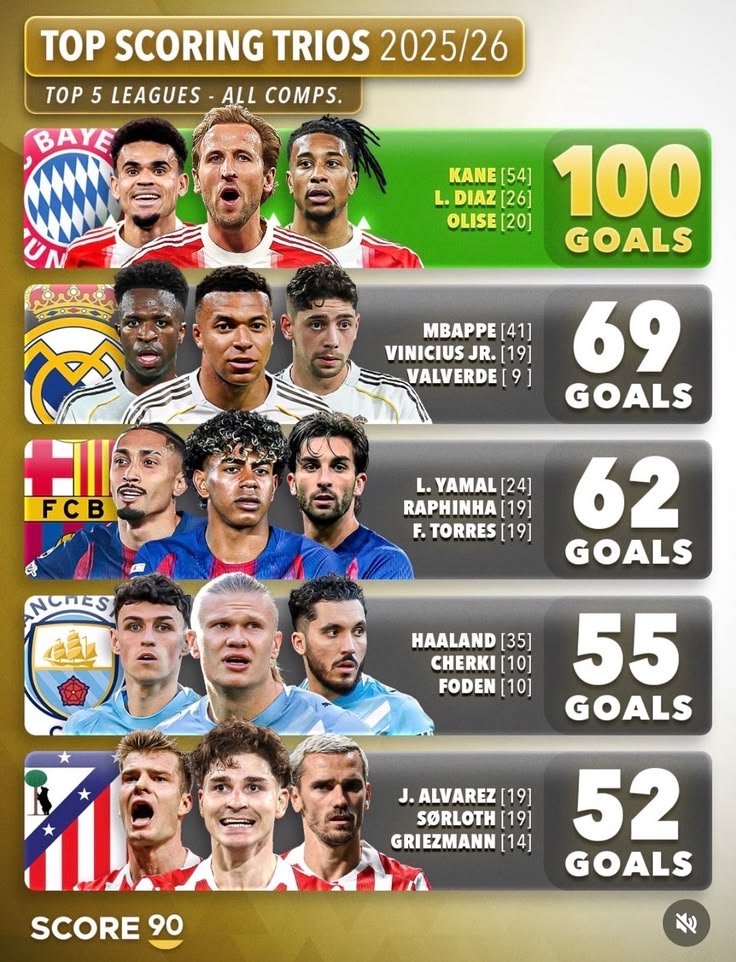
Top football scorers are players who have scored the most goals in a competition, season, club, or international tournament.
A top-scorer table may include:
| Player | Team | Goals | Matches |
|---|---|---|---|
| Player A | Team A | 20 | 25 |
| Player B | Team B | 18 | 24 |
| Player C | Team C | 16 | 23 |
Comparing goals with appearances can provide additional context when analyzing players.
Goals Per Match
Goals per match is a useful statistic for measuring scoring frequency.
The formula is:
Goals Per Match = Total Goals ÷ Matches Played
For example, if a player scores 10 goals in 20 matches:
10 ÷ 20 = 0.50 goals per match
This means the player averages half a goal per match.
Team Goals
Team goal statistics show how often a club or national team scores.
Important metrics include:
- Total goals scored
- Goals conceded
- Average goals per match
- Average goals conceded
- Home goals
- Away goals
- First-half goals
- Second-half goals
These numbers can help fans analyze attacking trends and overall team performance.
First-Half and Second-Half Goals
Football goals can also be categorized according to when they are scored.
For example, a statistics website might show:
| Period | Goals |
|---|---|
| 1st Half | 12 |
| 2nd Half | 18 |
| Total | 30 |
This type of data can help identify whether a team tends to score more before or after half-time.
Goal Difference
Goal difference is calculated by subtracting goals conceded from goals scored.
The formula is:
Goal Difference = Goals Scored − Goals Conceded
For example:
- Goals scored: 40
- Goals conceded: 25
- Goal difference: +15
Goal difference can be an important part of league standings and tiebreaking systems.
Football Goals and Match Analysis
Goals provide more than just the final score.
By analyzing when and how goals are scored, fans can study:
- Attacking patterns
- Defensive weaknesses
- Set-piece performance
- Counter-attacks
- Finishing efficiency
- Home and away performance
Combining goal data with statistics such as shots, possession, assists, and expected goals can provide a broader picture of team performance.
Football Goal Records
Football history contains many goal-scoring records.
These can include:
- Most goals in a season
- Most career goals
- Most goals in a tournament
- Most goals in a single match
- Fastest goal
- Most international goals
- Most goals for a club
Records can vary depending on the competition, statistical source, and period being measured.
Conclusion
Football goals are at the heart of the sport and form the basis of many important statistics. By studying goals scored, goals conceded, goal difference, goals per match, and top scorers, fans can better understand player and team performance.
For a football statistics website, goal data is essential for tracking players, teams, leagues, fixtures, results, records, and match performance.
Top Football Scorers, Football Player Stats وTeam Statistics.